make preferable
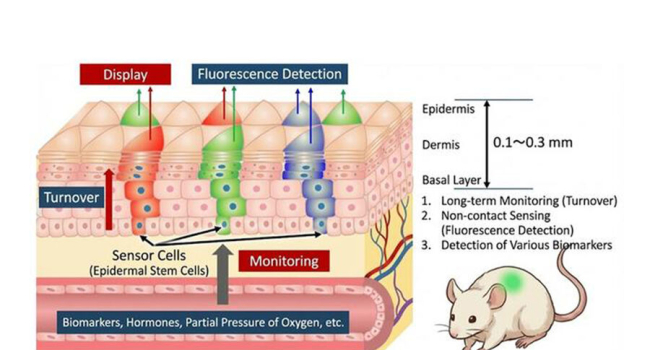
Wearable devices such as smartwatches have long made it possible to track heart rate and other parameters on the surface of the skin. Now Japanese scientists have taken a step further by developing a biohybrid approach that works inside the body. The technology involves a genetically modified skin graft capable of visually signaling internal biological processes. The study was published in Nature Communications (NatCom).
Unlike standard biomarker monitoring methods, which require blood tests or temporarily functioning external sensors, the new technology is integrated directly into the body. The system is based on epidermal stem cells—the cells responsible for skin renewal throughout life. The researchers genetically modified these cells so that they respond to activation of the NF-κB signaling pathway, which is associated with inflammation, by producing green fluorescent protein.
“Traditional methods are either invasive or provide only fragmented data,” explained Professor Hiroyuki Fujita, Distinguished Professor at Tokyo Metropolitan University and Professor Emeritus at the University of Tokyo. “We wanted to create a biologically integrated system that allows continuous monitoring of the body’s condition and intuitive interpretation of signals, even in a home setting.”
In experiments on mice, the transplanted skin successfully engrafted and became a functional part of the tissue. When inflammation was artificially induced, the grafted area began to glow green, effectively translating molecular signals from inside the body into an external visual indicator. Because the sensor consists of living stem cells, it is maintained through the skin’s natural renewal process.
“Unlike electronic devices that require batteries and regular replacement, this system is maintained by the body itself,” noted Professor Seiji Takeuchi of the University of Tokyo. “In our experiments, the sensor remained functional for more than 200 days thanks to continuous epidermal regeneration.”
By changing the molecular “targets,” the researchers believe it will be possible in the future to create skin-based sensors for monitoring other physiological or metabolic processes. Such solutions could find applications not only in human medicine, but also in veterinary practice and biomedical research, where visual indicators of health status are particularly valuable.