make preferable
Can you imagine a hospital room or kitchen countertop is free from bacteria, and not a single drop of disinfectant or boiling water is needed to zap the germs? That is the idea behind a startling discovery made by scientists in
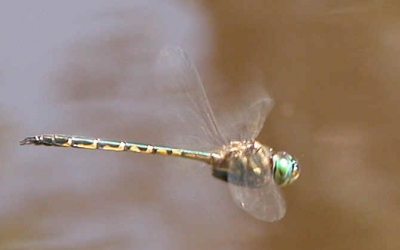
In a study published in the journal Nature Communications, they described how a dragonfly led them to a nano-tech surface that physically slays bacteria.
The germ-killer is black silicon, a substance discovered accidentally in the 1990s and now viewed as a promising semiconductor material for solar panels.
Under an electron microscope, its surface rips open the cell walls of any bacterium which comes into contact, the scientists found.
It is the first time that any water-repellent surface has been found to have this physical quality as bactericide.
Last year, the team, led by Elena Ivanova at Swinburne University of Technology in Melbourne, were stunned to find cicada wings were potent killers of Pseudomonas aeruginsoa — an opportunist germ that also infects humans and is becoming resistant to antibiotics.
Looking closely, they found that the answer lay not in any biochemical on the wing, but in regularly spaced "nanopillars" on which bacteria were sliced to shreds as they settled on the surface.
They took the discovery further by examining nanostructures studding the translucent forewings of a red-bodied Australian dragonfly called.
The dragonfly's wings and black silicon were put through their paces in a lab, and both were ruthlessly bactericidal.
Smooth to the human touch, the surfaces destroyed two categories of bacteria, called Gram-negative and Gram-positive, as well as spores, the protective shell that coats certain times of dormant germs.