make preferable
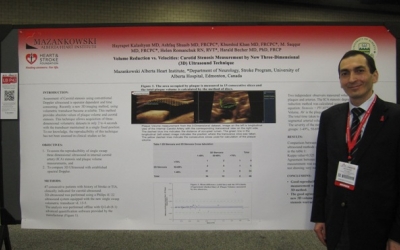
A new three-dimensional method for the atherosclerotic plaque measurement has been introduced at the University of Alberta Hospital, allowing a fairly fast diagnosis which is of vast importance for the stroke prevention. Our compatriot Dr. Hayrapet Kalashyan is among the investigators, who told NEWS.am Medicine about the new equipment.
It is known that nearly 16% of strokes is caused by severe carotid artery stenosis. The main cause of this stenosis is the formation of the atherosclerotic plaque on the wall of these arteries, which thus slows blood flow (sometimes causing a complete occlusion) towards the brain. This results in less supply of oxygen and glucose to the brain cells leading to malfunction or death of these cells. This is how the ischemic stroke is developed (ischemia means lack of blood).
As mentioned by Dr. Kalashyan, one of the main diagnostic methods for the carotid arteries is the ultrasound. It can define the degree of stenosis based on the blood velocities (Doppler). According to current guidelines if the carotid artery stenosis is greater than 70% (in some cases >50%) surgical intervention is necessary to prevent further strokes. In all other cases medical management is advised.
“Currently, though, for the prevention purposes the question of what to do with the patients who have no history of stroke but have an atherosclerotic plaque, or those with stroke and not enough stenosis of carotid artery to indicate surgery according to current guidelines, remains unanswered”. Or how to follow up the changes of this atherosclerotic plaque sizes during the medical treatment, to assess the effectiveness of the given treatment”: the Armenian neurologist says.
According to him the conventional two-dimensional (2D) ultrasound studies, which are widely used, have a limitation: they measure the plaque in one plane. Depending on the angle of the transducer the size of the plaque may vary widely. Hence the need for three-dimensional ultrasound arouse. It allowed to measure the volume of the plaque, which can be an accurate indicator for the severity of atherosclerosis and efficacy of preventive therapy.
However, this method had a serious disadvantage: it was cumbersome and time consuming. To acquire 3D data of a patient from 45 minutes to an hour was spent. The ultrasound transducer was drugged along the neck by hand with the sertain speed, which was almost impossible. Moreover, besides the ultrasound technique the use of additional devices was necessary. This is why these methods were used for research purposes only and did not get into daily clinical practice.
“The advantage of our method is that the investigation of a patient takes only 5 minutes, thanks to the automatization of the transducer. This means that there is no need to move the transducer by hand: the transducer has an internal device which sweeps the ultrasound beam over the area of interest. During that time transducer remains in the fixed position. The pictures are recorded and saved on the hard drive of the ultrasound machine. The acquisition takes only two seconds. The patient can leave after this. The processing and calculations are done offline and take 10 minutes in average'”: he explained.
Dr. Kalashyan and coworkers studied this method on a significant number of patients within a relatively short time period, to assess the reproducibility between two independent observers. And the results were impressive: this difference was only 5.6%. Thus, it became possible to implement this method into daily clinical practice and currently it is successfully used in the University of Alberta Hospital.
Note also that articles about this method have been published in the scientific journals with high impact factors: Atherosclerosis and Echocardiography and our compatriot is the first author in all of them. Dr. Kalashyan has presented the scientific reports in a number of prestigious scientific conferences including International Stroke Conference, American Society of Echocardiography meeting. An abstract has been accepted by World Stroke Congress which will take place in October.