make preferable
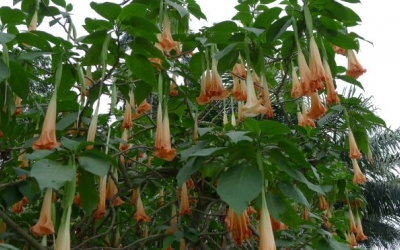
Brugmansia, known among people of South America as the “tree of the evil eagle,” is a potent medicinal and psychoactive plant that has played a prominent role in South American medicine and shamanic practice for centuries. All parts of the plant, especially the leaves and the flowers, have been employed as medicine. It has also been used in rituals and ceremonies for establishing contact with long-departed ancestors, Fox News reports.
Known as angel’s trumpets, the large bell-shaped flowers of the plant are beautiful to look at, and they emit a captivating fragrance in the evening as dusk settles.
In modern medicine, the tropane alkaloids found in brugmansia demonstrate a variety of uses, the plant’s scopolamine is used to relieve motion sickness when applied in a transdermal patch, mixed with opiates as an anesthetic used during childbirth, and in multi-ingredient asthma medications.
Hyoscyamine is used in the treatment of gastrointestinal disorders, including colic, diverticulitis, spasms, peptic ulcers and irritable bowel syndrome. When mixed with opiates, it helps to relieve neuropathic pain. Hyoscyamine has been marketed under numerous drug names.
Atropine is listed by the World Health Organization as an essential drug. If you have ever had your pupils dilated for an ophthalmological exam, atropine may have been the substance dropped into your eyes to achieve that effect. Cleopatra reputedly employed atropine from henbane to dilate her pupils for beauty enhancement, imparting a translucent gaze. Atropine also has a modern use for treating cardiac arrest and as a treatment for poisoning due to some nerve gases.
All three of the tropane alkaloids from brugmansia are poisonous even in modest quantities and must be used with great care. Consumed orally, they can cause nausea, vomiting, dizziness, rapid heartbeat, disorientation, hallucinations, erratic behavior, and even death.
When consumed as a tea, brugmansia can produce extreme and often hellish visions. Some shamans work primarily with brugmansia, seeing visions of evil serpents, man-eating jaguars and poisonous snakes.
A 2006 article published in European Archives of Psychiatry and Neuroscience detailed a tragic account of an 18-year-old German man who drank a cup of tea made from two brugmansia blossoms. A short while after drinking, he entered a small bathroom, where he severely mutilated himself. The young man had experienced amnesia after consuming the tea. He had no prior mental disorders. Brugmansia can distort all sense of reality and. Don’t drink brugmansia tea!