make preferable
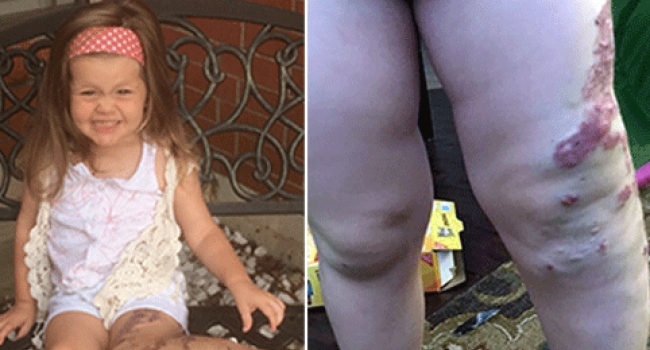
A two-year-old girl could develop a life-threatening blood clot at any time because she has twice as many veins as most adults.
Cambree Hensley's life is plagued by Klippel-Trenaunay syndrome (KTS), which affects just one in 100,000 people worldwide.
The condition impacts the development of blood vessels, soft tissues, and bones and means the toddler from Oklahoma City veins are much larger than usual.
She experiences pain every day, and her increased blood flow causes swelling putting her at high risk of developing a fatal blood clot.
But doctors can not tell her parents if or when this will happen, as every case of KTS is unique.
As a result of the condition, her left leg is two-and-a-half inches wider and an inch longer than her right.
And it often leads to her losing balance and falling over because the increased blood flow makes her leg heavier.
She wears specially designed shoes with a one inch orthopedic lift to help her walk.
Cambree's mother Ashley, 32, said: 'I feel scared out of my mind, but it's my job to be a strong mum for Cambree.
'Every day I get people saying, "What's wrong with her leg?"
'It hurts a little bit, but I've taught her to say, "It's my pretty birthmark".
'She is still our strong angel though and loves dancing around.'
Within seconds of Cambree's birth at Oklahoma's Norman Regional HealthPlex in August 2013, doctors noticed a port wine stain covering most of her left leg.
Not realising its implications, Mrs Hensley didn't care about the birthmark. All she wanted was to hold her baby.
Then doctors told her the mark could signify more serious underlying problems, and they would need to monitor it.
She broke down in tears and said the 'wonderful moment had been ripped away' from her.
The next morning, Cambree was examined by paediatricians and a dermatologist, who could not agree on a diagnosis, because KTS is so rare.
Six days later, Cambree's parents took their daughter to Cook Children's Hospital in Texas, three hours away.
Her parents were on tenterhooks as she was seen by a neurosurgeon, a genetics doctor and a haematologist.
They examined her birthmark, her vascular malformation and noted her left leg was two-and-a-half inches wider and an inch longer than the right.
Officially diagnosed with KTS at eight days old, doctors explained Cambree's condition was potentially life-threatening, because of the frequency of blood clotting.
Mrs Hensley said: 'We were happy to get a diagnosis, but nervous as we were told the condition gets worse with time.'
For the first eight months of Cambree's life, the family felt very isolated.
Then they found support through a Facebook group for KTS sufferers and their families.
Through the network, they discovered Boston's Children's Hospital in Massachusetts, had an excellent reputation for treating the condition.
Within two months of contacting them, surgeons there recommended closing off Cambree's extra vein, to slow down the blood flow.
And in April 2015, Cambree was admitted to the Boston facility for 'vein mapping' – a type of ultrasound used to monitor flow.
She also had a special glue inserted into the major veins to minimise it, laser treatment to toughen the skin on her leg to make bleeding easier, and sclerotherapy to shut off some of her smaller veins.
In September 2015, she returned for further laser therapy, surgery to remove three extra veins and a couple of non-life threatening blood clots in her leg.
Her parents are fundraising for annual check ups in Boston and further surgery, in a bid to close the main extra vein down and lower her chances of developing a debilitating blood clot.