make preferable
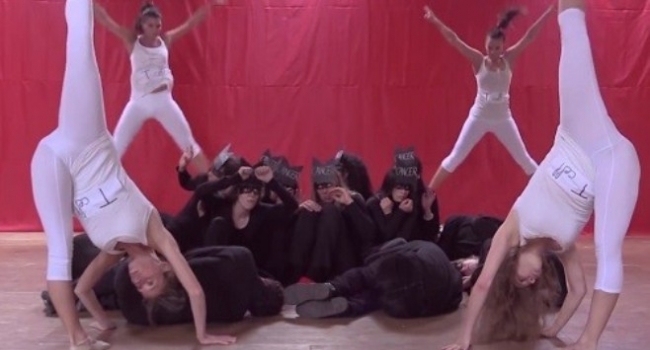
If you want to understand what Jacob Brubert’s Ph.D. in biomedical engineering was all about, you just need to watch him and his friends dance. To explain the science of heart valve bioengineering, Brubert’s crew, from the University of Cambridge, used tap dance, salsa, circus, and what can only be described as a cow doing the worm. And in the final scene, the group depicts the ugly truth about Ph.D. research: Sometimes it just doesn’t work. A dancing scientist laments “Whyyyyy …?” as the experiment—and the entire dance—falls apart.
The spectacle put Brubert over the top in this year’s Dance Your Ph.D., Science’s annual contest that challenges researchers to explain their research in the form of a dance. He wins $1000 for his effort and a trip to Boston next year for a screening and talk at the AAAS annual meeting. (AAAS is the publisher of Science.)
It wasn’t all experimental agony this year. Below are winners in the other categories. They each win $500.
Evgeny Sogorin, stuck with a fundamental science problem at the heart of his Ph.D. at the Institute of Protein Research in Moscow. Using an elaborate ballroom dance, he focused on the mystery of what prevents ribosomes from “jamming up” as they move along RNA strands expressing genes.
Carla Brown at the University of Glasgow in the United Kingdom, focused on a problem created by one of the great successes of science: the genetic spread of antibiotic resistance.
And what was your favorite? The internet has spoken. The People’s Choice Award goes to Emmanuelle Alaluf for a dance based on her biomedical Ph.D. research at the Free University of Brussels. You could read her papers about myeloid-derived heme oxygenase-1 and cancer—or you can watch her stunning ballet.