make preferable
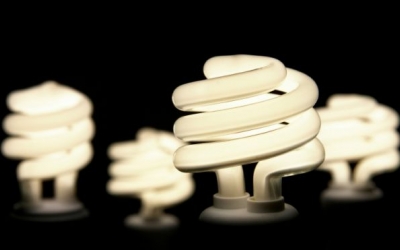
A 2007 bill is setting new efficiency standards for light bulb manufacturers, stating that 40 watt bulbs must draw just 10.5 W, and 60 W bulbs can only draw 11 W.
So how does this translate? Essentially, it means that incandescents will be going dark, while newer compact fluorescents (CFLs) and LED bulbs will be lighting up.
While this move is ultimately meant to conserve the nation’s available energy, the transition may actually not be so beneficial in other aspects. Broader use of CFLs may actually come with some unwanted health risks – most notably in regards to people’s skin.
The danger lies in the CFL design. Current fluorescent bulbs house a small tube of liquid mercury, and when the light is turned on, the incoming electricity changes some of that mercury into gas. This excited vapor emits invisible ultraviolet (UV) light, which is then absorbed by the bulb’s phosphor coating. The coating serves two purposes, both re-emitting the UV rays as visible light and shielding human skin from harm.
“Ultraviolet light is similar to the ultraviolet wavelengths found in natural sunlight, and we do not want huge amounts or extra amounts of ultraviolet light on our skin because it can cause biological effects that can lead to cancer,” Dr. Elma Baron, director in the lasers and photomedicine department at UH Case Medical Center in Cleveland, told FoxNews.com.
As a result, the researchers found that exposure to CFL bulbs caused damage to healthy human skin cells, similar to damage seen from ultraviolet radiation. However, it remains unclear how much exposure to a cracked CFL bulb is enough to cause serious adverse health effects.
Another concern surrounding CFL light bulbs has to do with their potential to trigger migraine headaches. According to Dr. Mark Green, director of the Center for Headache and Pain Medicine at the Icahn School of Medicine at Mount Sinai “The reality is fluorescent lighting rarely does trigger migraines, but it’s possible, and the reason for that is there is a flicker rate – the lights fire off at a certain rate, the way we trigger migraines in the lab is to give people a strobe effect.”