make preferable
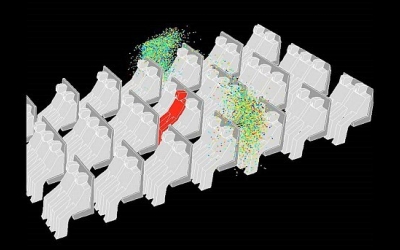
A person who sneezes while sitting in the middle of an aeroplane is likely to spread their germs throughout the whole cabin, a gruesome video shows.
The people sitting adjacent and behind the ‘sneezer’ are most at risk of infection from the sneeze, according to the video.
But the germy particles can travel much, much further, as this simulation shows.
It was created by ANSYS, a global company that uses mathematical models to simulate how air moves in aeroplanes, The Daily Mail reported.
This is in order to help the aviation industry and health officials understand how germs spread through a plane.
Immunisation experts warned today that when a person sneezes, their microbes can be found up to 50ft away, and the only way to protect oneself is to be vaccinated against them.
Ian Henderson, professor of microbial biology at the University of Birmingham’s School of Immunity, agreed with the images.
He told MailOnline: ‘It’s true - if somebody sneezes and they’re infected with flu, they will expel viruses in the cabin.
‘You can measure the dispersion of a sneeze up to 50ft. They really can spread a fair distance.
‘Anyone who is sitting close to an infected person will come into contact with that pathogen.’
But it will depend on factors like whether people have their vents open, he said.
However the risk of catching an infection is even higher in an office or a crowded cinema, he added.
This is because ‘in an aeroplane, the air is constantly filtered, turned over every two or three minutes.
‘The air in an office or cinema is not being filtered or exchanged.’
Although coming into contact with the microbes is likely, there will be other factors as to whether you catch an illness.
‘It depends on previous exposure,' he explained. 'If you’ve been exposed before, your immune system will have a response which will protect you.
It will also depend on the infectious dose: ‘If they sneeze in your face its worse’, he added.
The news comes amid a global crisis around the Ebola virus, but this is not an airborne pathogen which can be caught through sneezing.
Rhinovirus – the common cold – and flu, are the two people should worry about, Professor Henderson said.
He continued: ‘The principle applies to all forms of public transport.
‘I remember reading a paper about someone sneezing at the back of a double-decker bus and you could find the microbes at the front.’
However, he urged people not to be worried about coming into contact with microbes, which are a part of daily life.
He said: ‘People shouldn’t be terrified to leave their home.
'It’s almost impossible not to come into contact with microbes. You can’t avoid it. Even at home. We come into contact with thousands of microbes without becoming ill every day.
‘The best way to get infected is to get vaccinated. If there’s a vaccine, get it.’