make preferable
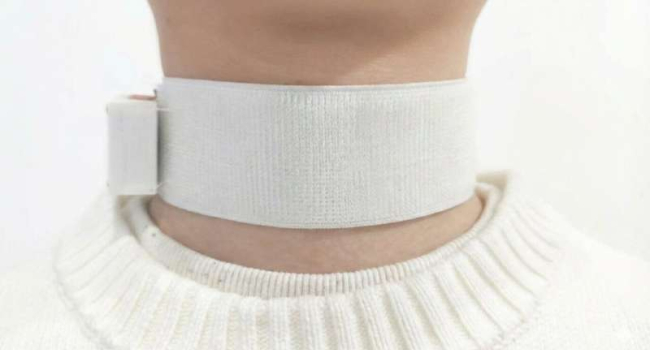
Researchers at the University of Cambridge have developed a wearable device, Revoice, that can restore speech in stroke patients without invasive brain implants, reports Nature Communications.
Revoice is a soft “choker” worn around the neck, equipped with highly sensitive sensors that detect micro-vibrations of the throat muscles and the user’s pulse. Artificial intelligence analyzes these signals and reconstructs the intended speech in real time, even if the person cannot speak aloud.
The technology is aimed at patients with dysarthria—a post-stroke speech disorder in which facial and vocal muscles are weakened. “The signals between the brain and throat muscles are disrupted, so patients know what they want to say but cannot express it,” explained Professor Luigi Occhipinti.
Revoice uses two AI modules: one reconstructs words from silent articulation, while the other analyzes context and emotional state, considering factors like pulse and stress levels. This allows the system to generate full, expressive sentences.
In a pilot trial with five patients, word-level errors were 4.2% and sentence-level errors 2.9%. By comparison, many alternative communication systems require slow text entry or eye-tracking.
In one example, three silently articulated words—“We go hospital”—were transformed into a full sentence reflecting emotion: “Although it’s already late, I still feel unwell. Can we go to the hospital right now?”
Participants reported a 55% increase in communication satisfaction. Developers plan expanded clinical trials and hope that Revoice will eventually become autonomous, support multiple languages, and capture a broader range of emotions.