make preferable
2014 was a particularly banner year for disease-related research and awareness, including but not limited to Ebola, Lou Gehrig’s disease, and cancer. It also wasn’t done solely by scientists. Nurses, cancer survivors, even golfers made contributions to medicine in one way or another. The Forbes journal unveiled this year’s list of 30 people under 30 famous in Medicine.
Salome Karwah, 26
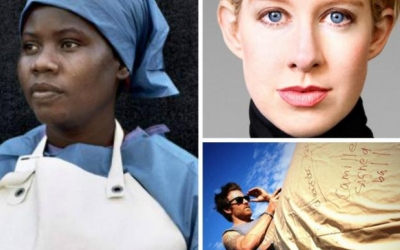
This year, the world witnessed the worst outbreak of the Ebola virus. Doctors, nurses, caregivers, directors, and scientists have stepped up this year to care, prevent, and treat the virus. Salome Karwah was one of the youngest nurse’s assistant at the Doctors Without Borders clinic in Monrovia. After losing both her parents and surviving Ebola herself, Salome stayed at the bedside of patients, bathing and feeding them
Nina Pham, 26
Ebola originated in West Africa, but nurse Nina Pham found herself face-to-face with the virus when Thomas Eric Duncan, a Liberian man who was experiencing symptoms, was brought in to Texas Health Presbyterian Hospital in Dallas.
Duncan died and Pham herself contracted. Luckily, the experimental drug Pham signed up to take worked, and she is now Ebola-free.
“There was a patient who needed help, and I was going to help him”,-said Nina Pham.
Chris Kennedy, 26
A lot of people spent their summer dumping buckets of ice cold water on their head to raise money for amyotrophic lateral sclerosis (ALC) — also known as Lou Gehrig’s disease. But when Jon Bullas, a golfer from Sarasota, Fla., challenged fellow golfer Chris Kennedy, it was considered the “24-Hour Charity Challenge.” Bullas donated to a children’s cancer charity, while it was Kennedy who chose to donate to ALS because of a suffering relative. So, he is technically who started the challenge we’re familiar with today.
Elizabeth Holmes, 30
Elizabeth Holmes was 19 when she dropped out of Stanford University to start her own company, Theranos. Her mission was to develop a new technology that would blood tests painless, more accurate, cheaper, and quicker. Holmes was able to create hardware and software that allow for blood tests to be done by pricking someone’s finger and storing the blood in a tiny vial called a nanotainer. Holmes’s company is now worth $9 billion, 50 percent of which she owns.
Tanay Tandon, 17
Tandon founded Athelas, a malaria blood-testing kit for smartphones. The young specialist says, his goal is to detect malaria in blood samples within seconds, as well as eventually train the algorithms to identify a variety of other diseases and conditions.
Divya Nag, 23
Most types of human cells, such as those found in the heart and liver, die when kept in a petri dish. The technology Nag has developed with her company Stem Cell Theranostics can turn cells into embryonic-like stem cells that can be used to create heart cells capable of living in a petri dish. This way, new drugs could be tested to replace heart tissue and eventually, they could replace heart tissue that dies during a heart attack.
Ludmil Alexandrov, 28
Alexandrov is famous for his researches in the field of cancer treatment. A paper he published in the journal Nature included a technique that found a signature for each mutation, which paves the way for scientists to see what causes it in the first place. Forbes reported this could inspire new ideas for cancer prevention.
Thomas Cantley, 31
Before being diagnosed with testicular cancer, Cantley did not pay attention to the pains he had.
He spent 2014 raising cancer awareness by first rolling a 6-foot-wide, giant rubber ball from Toronto to Vancouver in a homage to the testicle he lost, and then again from New York to Los Angeles.
In an appearance on The Doctors, Cantley pointed out the over 3,500 signatures from both fellow cancer survivors and those otherwise touched by the disease, whether they knew someone fighting or someone who lost their battle, now on the ball. Cantley doesn’t advise to roll a ball across the country, but to get checked by a doctor.