make preferable
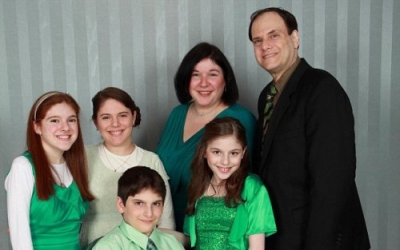
One New Jersey couple have watched in anguish as one by one of their four children inherited a mysterious disorder that has left doctors scrambling for answers.
Esther and Arthur Herzfeld's middle daughter Tziporah, 22, was the first to show signs of the curious ailment, when she started falling and tripping excessively in gym class at the age of 11.
Then came their only son Tzvi, 18, who went from walking to needing a wheelchair over the course of one summer.
'Imagine being completely healthy one day, and then one day you go to sleep, you wake up, you start walking funny and within the next year you can’t walk anymore,' Tzvi told The Record.
Daughters Racheli, 15, and Rivka, 23, were the final two Herzfeld siblings to show signs of the disorder, which makes everyday tasks like buttoning a shirt or getting off the couch enormous hurdles.
Despite the great burden, the family has remained positive and hopeful that a correct diagnosis will bring them a cure.
'I don’t ask, "Why did this happen to us and to our kids?"' Esther Herzfeld told FoxNews.com. 'That’s an unanswerable question - that’s a stupid question. I don’t have time to bemoan my fate. I just have to find comfort to go on.'
When Tziporah first started losing the ability to walk easily, a doctor said her condition appeared consistent with Charcot-Marie Tooth (CMT) Disease - a neurological disorder that impacts the peripheral nerves outside the brain and spinal cord.
Those with CMT typically have a high-stepped gait, weakness of small muscles in the feet and a habit of tripping or falling.
However, as each of the Herzfeld children started showing the same symptoms as Tziporah, the siblings were tested and each test came back negative for CMT.
Ruling CMT out, the Herzfeld children have baffled more than a dozen doctors who have run numerous pricey tests that fail to show what the root of their problem is.
Dr Helio Pedro, of Hackensack University Medical School, conducted a exome sequencing test on Rivka in August, one of the most advanced types of genetics testing (and priciest at upwards of $15,000 a test), and still couldn't find what the underlying problem was.
'Unfortunately, we do have families that have multiple children involved [in a genetic disease], and we do all the testing and we still can’t pinpoint exactly what the problem is,' Pedro said. 'It is a little bit concerning that we’ve done all this testing and still cannot really figure out what it is.'
However, Dr Pedro has been able to rule out an environment cause, since some family members do not show symptoms.
He also holds hope that advancing genetics technology could one day pinpoint the issue.
Rivka, the last of her siblings to inherit the unidentified disorder, says she spends a lot of her time researching her symptoms and remains positive that they will one day find an answer.
'At least for me, I need to know a name because a question mark isn’t really doing it for me,' she told North Jersey. 'We’re down. But we’re not out.'
But with no diagnosis, surgical procedures to help the Herzfeld's condition have been widely unsuccessful.
Both Tzvi and Racheli underwent surgery to lengthen their Achilles tendon, but the help didn't last for Tzvi and his sister developed knocked knees.
Doctors surgically implanted plates in Racheli's knees to straighten them, but when they started bothering her they had to be taken out.
Tziporah, meanwhile, had a muscle transfer surgery, in which doctors took muscle from a healthy part of her body and placed it in the foot in hopes to correct her drop foot. But instead, she just ended up feeling weaker.
Rivka is the only one of her siblings who has not undergone surgery, but life is no cake walk for her either. She sees a physical therapist once every other week and an occupation therapist once a week.
Until there's a diagnosis, the Herzfelds focus on battling the daily struggles of their mysterious condition.
For Tzvi, that means not being able to walk at all. But as the most out-going of his siblings, he does just fine getting around on a motor scooter which he even had signed by Michael Jordan.
Youngest sibling Racheli also uses a motor scooter, but just to get to and from classes at her high school where she is currently a sophomore.
Rivka and Tziporah can still walk as well, but they move slow and often with the fear that they could fall at any moment.
Other activities aren't as easy. All four children need their parent's help to get up off the couch since they have issues with their hips. And buttons and snaps are banned from their clothes because they don't have the strength or coordination in their hands to get dressed easily.
However, they remain resilient, no doubt in part to their parents, themselves the children of Holocaust survivors.
“It’s literally in their blood to fight and move on,' the family's rabbi Laurence Rothwachs told North Jersey.
While the Teaneck family has kept private about their health troubles for the past decade, they started sharing their story this year when they entered a contest to win a much-needed handicap-accessible van.
Though they didn't ultimately win the van, a private donor stepped up to pay for the $63,000 vehicle and the family has seen a wave of support from other strangers who are helping them tackle the $100,000 of debt they have accrued paying for their children's medical expenses and making their house more wheelchair friendly.
The Herzfelds have received help from their synagogue Congregation Beth Aaron, the United Way and other online funds set up by friends.
Rabbi Rothwachs hopes to eventually get enough money to rebuild the family's home or move them to a new home that would make it easier for their children to get around.