make preferable
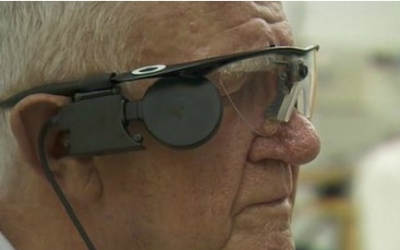
Ray Flynn, 80, has dry age-related macular degeneration which has led to the total loss of his central vision.
He is using a retinal implant which converts video images from a miniature video camera worn on his glasses.
He can now make out the direction of white lines on a computer screen using the retinal implant.
Mr Flynn said he was "delighted" with the implant and hoped in time it would improve his vision sufficiently to help him with day-to-day tasks like gardening and shopping.
The bionic eye implant receives its visual information from a miniature camera mounted on glasses worn by the patient.
The images are converted into electrical pulses and transmitted wirelessly to an array of electrodes attached to the retina.
The electrodes stimulate the remaining retina's remaining cells which send the information to the brain.
In a test, two weeks after surgery, Mr Flynn was able to detect the pattern of horizontal, vertical and diagonal lines on a computer screen using the implant.
He kept his eyes closed during the test so that the medical team could be sure that the visual information was coming via the camera on his glasses and the implant.
Mr Flynn said: "It was wonderful to be able to see the bars on the screen with my eyes closed."
The implant cannot provide any highly detailed vision - but previous studies have shown it can help patients to detect distinct patterns such as door frames and shapes.
Prof Stanga said that in time, Mr Flynn should learn how to interpret the images from the implant more effectively.