make preferable
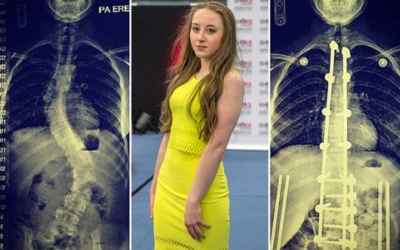
A teenage girl who felt like 'the Hunchback of Notre Dame' and spent years in searing pain due to a spinal disorder has defied expectations to become a model.
Tamara Sharpe, from Chelmsford, Essex, was diagnosed with scoliosis, a painful disease which results in abnormal twisting of the spine, when she was 13 years old.
As she grew, one shoulder became higher than the other, and she felt embarrassed and ashamed of her body, hiding her back away in baggy clothes and constantly comparing herself to other girls.
She had dreamed of becoming a ballet dancer, but her hopes were dashed as disease left her in agony.
By the time she was 16 her spine was so severely bent she could have ended up paralysed if she delayed having surgery.
After undergoing a series of major operations to straighten her spine, she is now working as a model and an actress, and wants to inspire other people with disabilities to follow their dreams.
Tamara, now 18, says her condition was first picked up when she was 13 by a dance teacher, who noticed one side of her back was higher than the other.

She said: 'Really, dancing saved my life.
'After my teacher pointed out the problem my mum took me to the doctor, and I was diagnosed with scoliosis.
'It can look really horrible - you get one shoulder higher than the other, one hip higher the other, and parts of your back stick out.
'It's not nice to look at, it's not pretty.
'I did actually call myself the hunchback of Notre Dame, because that's how it felt when I looked in the mirror.'
She had an operation to correct the curvature at 16-years-old, and by this time her spine was so curved it bent at a 65 degree angle.
She was taking painkillers on a daily basis, and doctors warned that if it had been left much longer, she could have ended up paralysed.
She said: 'When I first found out I was told the curve on my spine was 30 degrees, but I had to wait until I was 16 to have an operation as it depends on how you grow.
'It usually comes around in teenage years, brought on by hormone changes. I first noticed I had a problem with my hips when I was in ballet class doing kicks they started clicking as I moved.
'I went to the physio and he found my feet were turning in as well.
'It was very painful, it affected me really badly. My confidence was hit rock bottom.
'I was very self-conscious, everyday things like shopping were horrible because nothing would fit right.
'It was very frustrating, I would get very upset. I would just think to myself 'why am I not like other girls?'
As a result of the scoliosis, Tamara was crippled by shyness and tried to hide her illness from her friends.

She said: 'When I found out I didn't tell anyone and I tried really hard to hide it, I was embarrassed and ashamed of my image.
'Being in a performing arts school and doing a lot of ballet, you wear a lot of tight clothing and I didn't want people to stare at me.
'I would wear baggy clothing to hide myself away, and when teachers told me to take it off I would stand at the back, and hope that no one noticed me.
'Teachers were very supportive when they knew what was wrong with me, but there wasn't a lot they could do.’
Tamara was diagnosed with idiopathic scoliosis, which mean the cause of her scoliosis is unknown. Around eight out of 10 cases of scoliosis are idiopathic.
In Tamara's case, her spine was fused from T2 to L3 - which means all but two of her vertebrae, the bones in the spine that surround the spinal cord, had fused together.
She had an operation in September 2013 to remove ribs and deflate her left lung so that doctors were able to carry out a second operation on October 1 2013 to straighten her spine.
Surgeons put in two rods and screws into her back to straighten her spine.
Having the operation was a 'scary' experience, as she had to re-learn basic skills including how to eat and walk, she said.
'I wore a back brace for four months and had to sleep in a corset every night, which isn't ideal when you're 16,' she added.
'I was surprised at how supportive everyone was - I tried for so long to hide it, I didn't expect the reaction I got when I told my college friends after the operation.
'They skyped me nearly every day in hospital, and when I went back to college they would carry my bags for me.