make preferable
A nursery school teacher suffers from a mysterious condition causing her to cry 'crystal' tears.
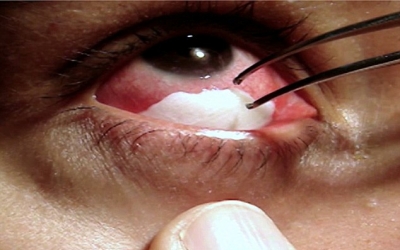
Laura Ponce, of Lins, Brazil, has a strange affliction, which means white plaques rise up in her eyes for weeks at a time.
As the 35-year-old blinks to expel a clot of white plaque, another starts to form.
Initially it is soft but as it reaches the air close to the surface of her eye, the texture changes and it becomes a solid crystal.
Sometimes Miss Ponce has to take time off work, removing up to 30 hard white plaques, which form into a membrane on her eye, a day.
Miss Ponce said: 'A clot starts to swell then I have to open my eye to take out the membrane.
'When it dries it hardens, it gets really hard, it hurts a lot.'
The 35-year-old first noticed the 'crystal' tears when she was just 15 as her eye started filling up with an unknown white substance.
She called for her mother, Marissa, who was horrified, and the pair had to continually remove hard white plaques from her swollen eye socket.
Her mother said they checked inside the eye and there was a thick membrane over her eye.
Mrs Ponce said: 'We took it out and I was scared. We ran to the ER and the doctor on duty also got scared. The doctor was mystified.'
For the next 20 years Miss Ponce experienced an episode every few months and the family searched to find someone who could explain her mysterious condition.
'The whole family was shaken - we went chasing doctor after doctor,' Mrs Ponce said.
Miss Ponce is often trapped at home because she has to remove scores of the white membranes from her eyes.
'I'm a nursery school teacher, I get angry not being able to work,' she said.
'Two years ago it was infected for six months and I was taking 30 membranes out of my eye each day.'
Now, after two decades of suffering a doctor might have discovered the cause of her crystal tears.
Dr Raul Goncalves, an ophthalmologist at Hospital de Olhos de Bauru, Brazil, said they are yet to find a case such as Miss Ponce's in medical literature.
After running a series of tests on a jar of her crystallised tears, he now believes the white crystals are due to her eyes producing excessive amounts of keratin.
Dr Goncalves said: 'I have been an ophthalmologist for 25 years and I have never seen anything like it.
'For these plaques to form so fast there could only be one explanation, it must be chemical.
'Every time we blink you're lubricating your eye, and tears are made of three layers - a water layer, a mucin layer and a fat layer.
'Each cell separately creates a product and when you blink you mix all this like a dough.'
When bacteria attack the eye the protein content of the tear should defend it - but in Miss Ponce's case this first form of defence is failing, he explained.
'Her eyes are forced to produce the second line of defence,' the doctor said.
'The cornea jumps into action, and in Miss Ponce's case the cornea's surface can secrete keratin.
'This keratin together with other components causes the tears crystallisation.'
Dr Goncalves has prescribed silver nitrate eye drops to manage Miss Ponce's condition.
Now the nursery teacher has much fewer eye infections and can go back to work.
She said: 'My expectations are for my eyes to be cured and for everything to be fine.'