make preferable
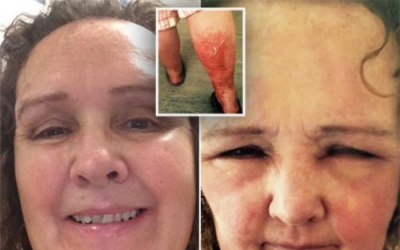
A mother-of-two was left in absolute agony and fearing she would die, after a rare allergy to medication caused her face to swell and 'split open like a sausage'.
Karen Simmons, 58, was diagnosed with epilepsy in June 2012, and prescribed medication. But four days later she fell ill with a temperature of 44°C.
An angry rash began to spread across her arms and legs, engulfing her body and reaching her face. Unable to stand and fearing for her life, Mrs Simmon's husband Steve, 57, drove her to Chase Farm Hospital in Enfield, Middlesex.
Within 48 hours of arriving at the hospital her skin was splitting and shedding 'like a snake.'
A dermatologist diagnosed her with Stevens-Johnson Syndrome (SJS), a rare and life-threatening skin condition triggered by an allergy to her epilepsy medication.
Mrs was diagnosed with epilepsy in June 2012, and prescribed medication. But four days later she fell ill with a temperature of 44°C.
They stopped her taking the drugs immediately and tried to treat the reaction, but she was left unrecognisable for eight weeks as her skin would not stop burning and blistering.
Despite being in 'unbearable pain', she says the thought of seeing her puppy Cupcake again gave her something to look forward to, and she is now recovering at home with her husband and her dog.
Mrs Simmons, from Cheshunt, Hertfordshire, said: 'It was absolute torture. My skin was puffing up and flaking off and no one could say what was wrong with me.
'My health problems started in January 2012 when I passed out in the middle of the night.
'With two black eyes and a broken nose, I went to hospital where I underwent tests.
'A few months later I was diagnosed with epilepsy, and put on the medication Carbamazepine, which stops epileptic seizures.
'Just four days after that, in June 2012, I started feeling feverish. My temperature was through the roof.'
Mrs Simmons, a former London ambulances service worker, went to her GP who diagnosed her with measles.
Stevens-Johnson Syndrome (SJS) is a rare disorder that begins with flu-like symptoms.
These are followed by a painful red or purplish rash that spreads and blisters.
Then the top layer of the affected skin dies and sheds.
The illness, which is a form of Toxic Epidermal Necrolysis, is typically a reaction to a drug or an infection, and can prove fatal.
Treatment focuses on eliminating the underlying cause, controlling symptoms and minimizing complications.
Patient recovery can take weeks to months, depending on the severity of the syndrome.