make preferable
There are numerous apps and websites that let you manually count your calories but the process can be tedious and often inaccurate.
From next year, though, keeping track of what you're eating could be as simple as pointing a scanner at it.
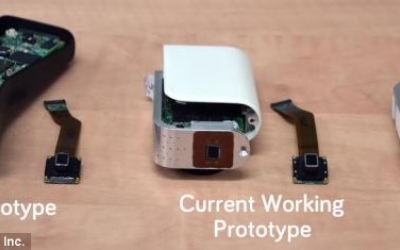
An Israeli firm has created Scio, a handheld scanner that uses beams of light to detect the amount of fat, carbohydrates and protein in food by analysing its 'molecular signature.'
Scio was designed by Consumer Physics and the firm successfully funded production of the gadget on Kickstarter last year.
It is hoping to launch the product next year and Scio is available to pre-order now for $249 (£160).
Test devices have also been released to 1,000 companies, allowing them to create apps using the technology.
Scio uses beams of light to analyse the molecular 'signature' of whatever it is scanning.
This is known as near-IR spectroscopy and is based on the fact that each type of molecule vibrates in its own unique way, and these vibrations interact with light to create a unique optical signature.
To analyse a food item, the user beams light from Scio to the foodstuff they want to analyse.
It then transmits the information via a Bluetooth connection to a smartphone, which in turn sends it to a database that looks up the 'signature' and identifies what the foodstuff is.
Once it has been identified, the information appears on the user's smartphone.
To accurately assess the number of calories, the user will have to identify the portion size of the piece of food that is being scanned.
Spectrometry is used in various scientific fields for analysing everything from chemicals in labs to the makeup of distant stars.
Spectrometers have been traditionally large and bulky, however, so a pocket-sized version could represent a major breakthrough.
Consumer Physics demonstrated the gadget at the Wired 2015 technology conference in London.
The device may also prove useful to emergency services personnel for identifying pills using the same method.
Dror Sharon, the company's chief executive demonstrated the hand-held device successfully identifying a Viagra tablet.
Commenting on the device on the company's website, Mr Sharon said: 'Our pill-scanning application is all about identifying the pill itself. In fact, it can distinguish between a brand-name aspirin and generic aspirin.'
Mr Sharon said his company was building a 'database of matter' in various areas such as food and medicines.