
 make preferable
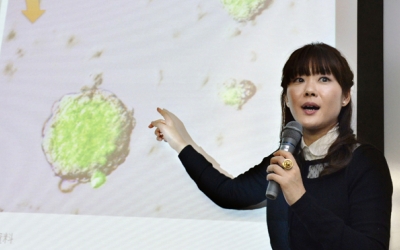
Research body of Japan accused the writer of 'the breakthrough' stem cell papers in the field of medical biology of misconduct involving fabrication, but the scientist called the findings unacceptable.
Two papers published in the scientific journal Nature in January detailed simple ways to reprogram mature animal cells back to an embryonic-like state, allowing them to generate many types of tissues, Fox News reports.
Such a step would offer hope for a simpler way to replace damaged cells or grow new organs in humans.
But reports have since pointed out irregularities in data and images used in the papers, prompting RIKEN, a semi-governmental research institute and employer of the lead writer, to set up a panel to look into the matter.
The panel said, for example, that one of the articles reused images related to lead writer Haruko Obokata's doctoral dissertation, which was on different experiments.
In a statement, Obokata said she would soon file a complaint with RIKEN.
Obokata became an instant celebrity in Japan after the publication of her papers, with television broadcasting images of her wearing a traditional Japanese apron, rather than a lab coat, and working in a laboratory with pink-painted walls.
RIKEN said it planned to launch a verification process to see if the Stimulus-Triggered Acquisition of Pluripotency or STAP cells were real. That will take about a year to complete and will be led by RIKEN President Ryoji Noyori, a 2001 Nobel laureate in chemistry.





