
 make preferable
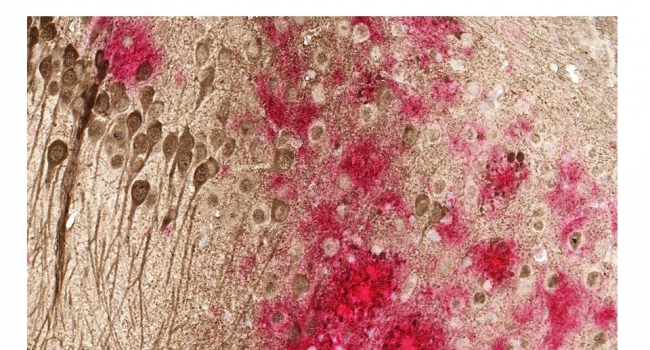
Scientists from Sanford Burnham Prebys Medical Discovery Institute (SBP) have identified gene recombination in neurons that produces thousands of new gene variants within Alzheimer's disease brains. The study, published today in Nature, reveals for the first time how the Alzheimer's-linked gene, APP, is recombined by using the same type of enzyme found in HIV.
Using new analytical methods focused on single and multiple-cell samples, the researchers found that the APP gene, which produces the toxic beta amyloid proteins defining Alzheimer's disease, gives rise to novel gene variants in neurons -- creating a genomic mosaic. The process required reverse transcription and reinsertion of the variants back into the original genome, producing permanent DNA sequence changes within the cell's DNA blueprint.
"We used new approaches to study the APP gene, which gives rise to amyloid plaques, a pathological hallmark of the disease," says Jerold Chun, M.D., Ph.D., senior author of the paper and professor and senior vice president of Neuroscience Drug Discovery at SBP. "Gene recombination was discovered as both a normal process for the brain and one that goes wrong in Alzheimer's disease."
One hundred percent of the Alzheimer's disease brain samples contained an over-abundance of distinct APP gene variants, compared to samples from normal brains. Among these Alzheimer's-enriched variations, the scientists identified 11 single-nucleotide changes identical to known mutations in familial Alzheimer's disease -- a very rare inherited form of the disorder. Although found in a mosaic pattern, the identical APP variants were observed in the most common form of Alzheimer's disease, further linking gene recombination in neurons to disease.
"These findings may fundamentally change how we understand the brain and Alzheimer's disease," says Chun. "If we imagine DNA as a language that each cell uses to 'speak,' we found that in neurons, just a single word may produce many thousands of new, previously unrecognized words. This is a bit like a secret code embedded within our normal language that is decoded by gene recombination. The secret code is being used in healthy brains but also appears to be disrupted in Alzheimer's disease."
The scientists found that the gene recombination process required an enzyme called reverse transcriptase, the same type of enzyme HIV uses to infect cells. Although there is no medical evidence that HIV or AIDS causes Alzheimer's disease, existing FDA-approved antiretroviral therapies for HIV that block reverse transcriptase might also be able to halt the recombination process and could be explored as a new treatment for Alzheimer's disease. The scientists noted the relative absence of proven Alzheimer's disease in aging HIV patients on antiretroviral medication, supporting this possibility.
Source: sciencedaily.com





