
 make preferable
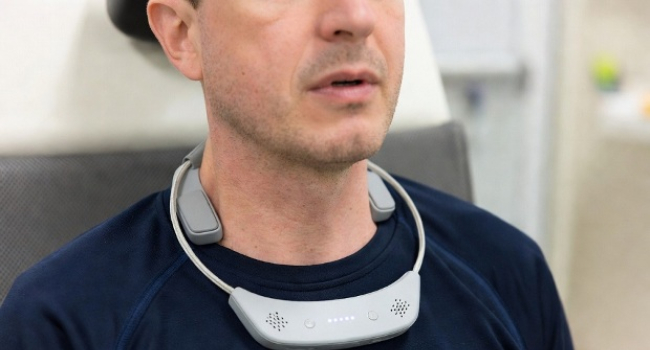
Scientists at the University of Cambridge have developed a unique wearable device called Revoice that could radically change the lives of people with speech impairments after stroke, such as dysarthria—a condition in which the muscles of the face, mouth, and larynx are weakened, preventing clear verbal expression.
The study describing the breakthrough was published in Nature Communications.
Unlike traditional assistive technologies that rely on letter-by-letter input, eye tracking, or invasive brain implants, Revoice converts barely perceptible bodily signals into fluent, natural speech in real time.
The device is designed as a soft, flexible “choker” worn around the neck, making it comfortable for all-day use. Built-in ultra-sensitive sensors detect microvibrations of the throat muscles that occur even when a person moves their lips without producing sound, as well as pulse signals used to assess emotional state. These data are fed into an artificial intelligence system consisting of two modules: one interprets fragments of silent articulation and reconstructs words, while the other analyzes emotions and context—such as time of day or the user’s mood—to automatically expand short phrases into full, expressive sentences.
In a small trial involving five patients with dysarthria, the system demonstrated a very low error rate: word-level errors were about 4.2%, while sentence-level errors were just 2.9%. Participants also reported an approximately 55% increase in communication satisfaction, as it became easier for them to express complex thoughts rather than only individual words.
For example, a short mentally articulated phrase like “We go hospital” could be expanded by the system into a more detailed sentence that incorporates emotion and context—such as, “Although it’s already late, I still feel unwell; could we go to the hospital now?”—making communication more natural and human.
The authors note that the technology is still at the prototype stage and that larger clinical trials, vocabulary expansion, multilingual support, and fully autonomous operation without external servers are needed. Nevertheless, even at this stage the device shows strong potential to significantly ease social interaction, reduce patient isolation, and improve quality of life after stroke and in other neurological conditions.





