
 make preferable
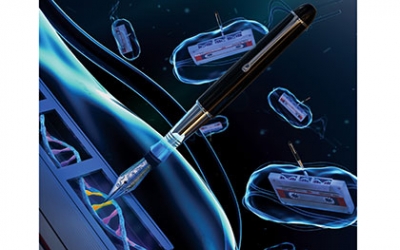
Treating the genome as so much living circuitry, synthetic biologists hope to create designer cells, even “computerized” cells. Such cells could, for example, be used as biosensors to record environmental input, which could be stored for long periods, perhaps as long as the cells keep dividing. Stored information could be read in a variety of ways including DNA sequencing, Genetic Engineering and Biotechnology News reported.
To date, cells that have been engineered to record environmental information have been capable of digital memory only. That is, they could record only all-or-nothing memories, such as whether a particular event occurred. Now, however, scientists at MIT report that they have created a living system for storing analog memory. The scientists say that their system can reveal how strong a particular environmental input was or how long it lasted.
The system presents a couple of different ways to retrieve stored information. If the DNA is inserted into a nonfunctional part of the genome, sequencing the genome will reveal whether the memory is stored in a particular cell. Or, researchers can target the sequences to alter a gene.
For example, in the current study, the new DNA sequence turned on an antibiotic resistance gene, allowing the researchers to determine how many cells had gotten the memory sequence by adding antibiotics to the cells and observing how many survived.
By measuring the proportion of cells in the population that have the new DNA sequence, researchers determined how much exposure there was and how long it lasted. In this paper, the researchers used the system to detect light, a lactose metabolite called IPTG, and an antibiotic derivative called aTc, but it could be tailored to many other molecules or even signals produced by the cell.
The information can also be erased by stimulating the cells to incorporate a different piece of DNA in the same spot. This process is currently not very efficient, but the researchers are working to improve it.





