
 make preferable
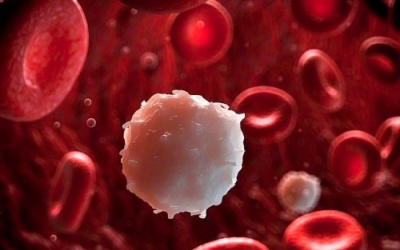
Injecting white blood cells with a special protein transforms them in to 'super natural killer cells’ that can wipe out cancer experts have revealed.
The specially engineered cells have the ability to seek out diseased cells in lymph nodes, with one purpose: destroy them.
The breakthrough by biomedical scientists at Cornell University, could stop the disease in its tracks, by preventing it from spreading.
'We want to see lymph node metastasis become a thing of the past,' said Michael King, the Daljit S, and Elaine Sarkaria, professor of biomedical engineering and senior author of the paper.
For cancer tumour cells, the lymph nodes are a key staging area, playing a crucial role in advancing metastasis throughout the body.
In the study, biomedical engineers killed the cancerous tumour cells within days, by injecting liposomes armed with TRAIL (tumour necrosis factor related apoptosis-inducing ligand).
These then attach to 'natural killer' cells - a type of white blood cell - residing in the lymph nodes.
Professor King said these natural killer cells become 'super natural killer cells'.
They induce a state known as apoptosis, where the cancer cells self-destruct and disintegrate, preventing them from spreading through the lymphatic system to other organs in the body.
Professor King said: 'In our research, we use nanoparticles - the liposomes we have created with TRAIL protein - and attach them to natural killer cells, to create what we call "super natural killer cells" and then these completely eliminate lymph node metastasaes in mice.'
In cancer progression there are four stages.
At stage I, the tumour is small and has yet to progress to the lymph nodes.
In stages II and III, the tumours have grown and likely will have spread to the lymph nodes.
At stage IV, the cancer has advanced from the lymph nodes to organs and other parts of the body.
Between 29 and 37 per cent of patients with breast, colorectal and lung cancers are diagnosed with metastases in their tumour-draining lymph nodes - those lymph nodes downstream from the cancer.
And, as a result those patients are at a higher risk for distant-organ metastases and later-stage cancer diagnoses.
In January 2014, Professor King and his colleagues published research that demonstrated by attaching the TRAIL protein to white blood cells, metastasising cancer cells in the bloodstream were killed off.
'So, now we have technology to eliminate bloodstream metastasis, our previous work, and also lymph node metastases,' Professor King said.
The study was funded by the non-profit organisation Lynda's Kause Inc, started by Lynda King, who died from cancer in July 2014 and is no relation to Professor King.
The foundation funds research into metastatic cancer and patient support.
The study is published in the journal Biomaterials.





