
 make preferable
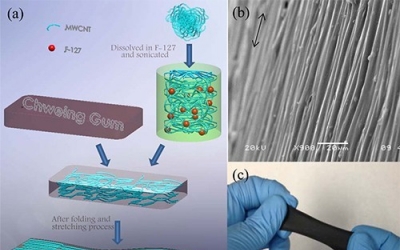
Canadian chemists have transformed their used chewing gum into super-flexible medical devices so sensitive, they can track your breathing.
Medical body sensors are currently used to monitor vital functions such as heart rate, steps and sleep patterns, but most of them are made of metal and can't withstand extreme strain.
The stretchy sensor created at the University of Manitoba, instead, keeps working even if twisted and bent repeatedly.
In the past, researchers have experimented with silicone and other plastics in order to make elastic sensors that could monitor the motion of any part of the human body.
But those devices, despite being stretchy, were less sensitive to minimal body movements than metal equivalents.
The new sensor was created by chemists at the University of Manitoba using a spent piece of gum that, after being chewed for half an hour, was doused in ethanol and let to rest overnight.
A day later, the researchers mixed the gum with carbon nano-tubes - nanometre-thick cylinders of carbon atoms that have extraordinary conductive properties and can be used as sensing material.
The gum was then stretched, twisted and folded repeatedly to uniformly distribute the tubes on the gum's surface.
Initial tests of the gum sensor, which involved testing how it monitored finger bending and head turning, revealed that it can work even when stretched 530 per cent.
Unlike its silicon-based alternatives, the chewing gum sensor also demonstrated a high sensitivity, being able to trace 'slow breathing.'
Interestingly, the sensor also has the unexpected property such as detecting changing humidity levels.
This could help further monitor human breathing, as people exhale water vapour during the process.
The researchers reported their findings on the American Chemical Society's Applied Materials & Interfaces journal.
In the paper, they explained that the chewing-gum sensor can be fashioned into very different shapes, which make it possible to use the technology to create miniaturised sensors and biochips.
This is not the first attempt to invent more accurate fitness trackers by thinking outside the box.
Last month, the software collective Chaotic Moon put forward its idea for smart tattoos that keep track of its user's vital functions through special paint and micro-sensors.





