
 make preferable
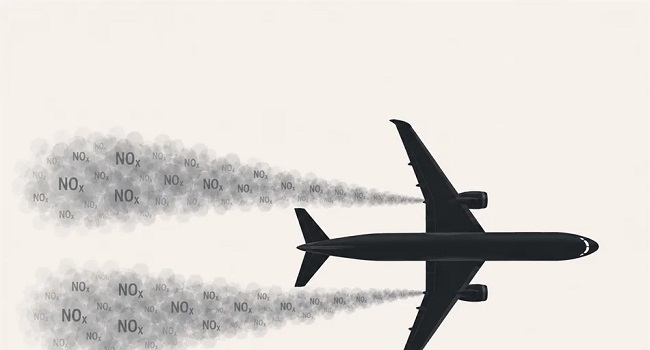
Emissions from commercial aviation may already be linked to tens of thousands of premature deaths worldwide each year, and this burden could more than double by 2040. That is the conclusion of a large modeling study conducted by researchers from Delft University of Technology and University of Cambridge, published in the journal Communications Earth & Environment.
The researchers examined how aviation emissions affect air quality and public health by comparing atmospheric models that included aircraft emissions with those that did not. Particular attention was given to nitrogen oxides (NOₓ), which are considered the primary aviation-related contributors to air pollution.
Aircraft release pollutants both during takeoff and landing and while cruising at high altitudes. Much of these emissions enter the upper troposphere and lower stratosphere, where pollutants can travel thousands of kilometers and contribute to the formation of secondary pollutants, including fine particulate matter (PM2.5) and ground-level ozone.
According to the study’s estimates, aviation emissions in 2019 were associated with approximately 33,900 additional deaths linked to PM2.5 exposure, another 24,600 deaths related to ozone pollution, and about 6,700 deaths associated with nitrogen dioxide. The greatest health burden was observed in densely populated regions of Asia, home to a large share of the world's population.
The analysis showed that aviation’s impact is unevenly distributed. Elevated ozone concentrations were detected across vast geographic areas, while increases in PM2.5 were particularly pronounced in heavily populated regions of Europe, North America, and Asia. In some locations, aviation accounted for more than 2% of airborne fine particulate matter concentrations.
The authors emphasize that the majority of aviation’s contribution to global air pollution originates from emissions released during flight rather than solely near airports. Nevertheless, communities surrounding major airports remain areas of heightened risk, particularly with regard to nitrogen dioxide exposure.
If current trends continue, the researchers project that by 2040 the number of premature deaths associated with aviation emissions could rise to approximately 68,000 annually from PM2.5 exposure and 54,000 from ozone exposure under a baseline growth scenario. Under a higher-growth aviation scenario, those figures could reach 83,800 and 66,300 deaths per year, respectively.
The study also highlights a significant challenge: even the adoption of cleaner aviation fuels may not fully solve the problem. While such fuels can help reduce the industry's carbon footprint, they do little to eliminate nitrogen oxide emissions. These compounds play a central role in the formation of pollutants that are harmful to human health.
The researchers note that the exact estimates depend on the modeling approaches and risk-assessment methods used, meaning real-world figures may differ. However, the overall conclusion remains consistent: without additional measures to reduce nitrogen oxide emissions, aviation’s impact on public health is likely to increase as air travel demand and global population continue to grow.





