make preferable
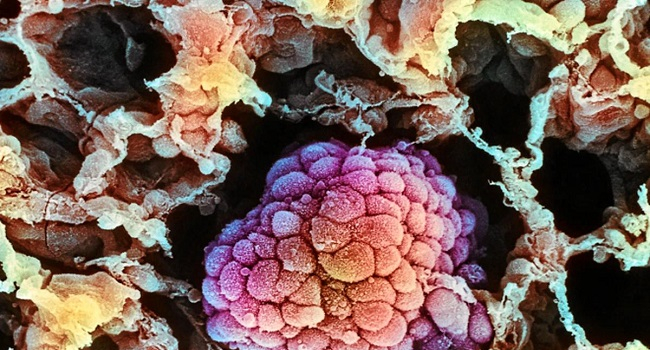
Researchers at Rockefeller University have uncovered why the protein MLL4 can play opposite roles in different types of cancer. Their study, published in Molecular Cell, shows that MLL4 not only regulates gene activity but also directly supports one of the body's most important tumor-suppressing proteins, p53.
MLL4 belongs to a family of proteins that modify chromatin—the complex of DNA and proteins that packages genetic material—and thereby control whether genes are switched on or off. However, its role in cancer has long puzzled scientists. In certain forms of leukemia, MLL4 appears to promote tumor growth, whereas in most solid tumors it acts as a tumor suppressor.
To understand this paradox, the researchers generated the first complete three-dimensional structure of the nine-subunit MLL4 complex. They combined cryo-electron microscopy, genetic approaches, and a laboratory transcription analysis system to reveal how the protein functions.
The team found that MLL4 anchors itself to the nucleosome—the basic structural unit of chromatin—using a rigid scaffold. It then employs a flexible region of the molecule to locate histone proteins and add specific chemical marks that serve as signals for gene activation.
The study also uncovered a previously unknown function of MLL4. Researchers discovered that the protein acts as a direct co-activator of p53, often referred to as the "guardian of the genome." The p53 protein activates genes responsible for repairing damaged DNA, halting the division of defective cells, and triggering programmed cell death when the damage cannot be repaired.
When the researchers experimentally disabled the MLL4 gene, the activity of many p53-controlled genes declined significantly. This finding suggests that without MLL4, the tumor-suppressing functions of p53 become much less effective.
According to the authors, this discovery helps explain why MLL4 suppresses the development of many solid tumors—it enhances p53's ability to activate anti-cancer genetic programs. In contrast, in certain types of leukemia, MLL4 interacts with different gene regulators, supporting the growth and survival of cancer cells instead.
The researchers now plan to investigate how MLL4 switches between these two opposing roles. Understanding this mechanism could pave the way for new cancer therapies that inhibit MLL4 in leukemia while preserving its tumor-suppressive activity in other forms of cancer.