make preferable
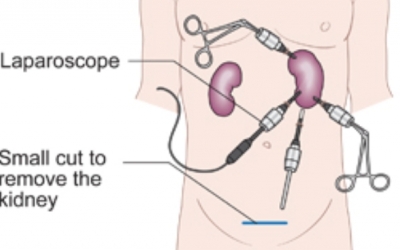
It is no coincidence that advances in keyhole surgery ten years ago led to a steady rise in the number of people deciding to donate a kidney. The operation, which can be performed via an incision so tiny that it can be hidden in the belly button, was carried out 1,068 times in 2012.
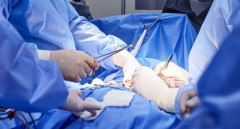
Yet one of Britain's leading transplant surgeons now argues that a back-to-basics approach to open surgery - using fingers as well as surgical instruments - offers the best outcome for donors and transplant recipients.
The technique, known as finger-assisted nephrectomy, has been pioneered by Professor Nadey Hakim. It reduces the operating time from between two and three hours to just 45 minutes, and according to new research, the donor is at lower risk of complications. The reduction in operating time also means the kidney is fresher for transplant and there is less chance of the organ being damaged during retrieval.
Prof Hakim's unit at Imperial College Healthcare Trust in London is the only one of 30 UK transplant centres to use this method. A handful of European surgeons are also adopting his approach.
'With keyhole surgery, you are making four or five holes for the instruments plus a 3in incision to remove the organ,' explains Prof Hakim. 'Complications include accidental injury to the bowel or a blood vessel which can damage the kidney itself. Getting the organ out of the patient itself takes longer once you have separated the kidney. And the longer the kidney remains disconnected without cooling, the greater chance of delayed function.'
Finger-assisted nephrectomy means that the organ is 'on ice' a matter of minutes after it is separated from its blood supply.
'Patients are absolutely delighted because we leave them with such a tiny incision'
Prof Hakim adds: 'Keyhole surgery is a fine technology, but it is not without risk and there are still merits in old-fashioned open surgery.
Historian David McDowall, 68, decided to donate one of his kidneys to a stranger last year. The father-of-two from South London was delighted with his small scar and the fact that he was able to resume normal activities within a month of the procedure.
Mr McDowall, who had his surgery last autumn, says: 'I decided to donate after surgeons at another hospital saved the life of one of my grandchildren - I wanted to give something that might help save another life. No one in my family needed a transplant, so I decided to donate to a stranger. My recovery was very fast. Six weeks later, it was if I hadn't had surgery at all.'
Nicos Kessaris, a transplant surgeon at Guy and St Thomas' Hospital in London, says Prof Hakim's technique is widely admired. 'There's no doubt that he is a highly skilled surgeon and there is no reason why this technique couldn't be used at other centres,' he adds.