


- Latest news▼
-
18:14, October 24 How Ultra-Processed Foods Affect Children's Brains: Study Links Brain Activity to Weight Gain

-
15:39, October 24 Scientists Create Immune Cell Atlas That Could Help Assess Cancer Risk and Premature Death

-
13:42, October 24 New mRNA Vaccine Reduces Risk of Melanoma Recurrence After Surgery by 42%

-
08:37, October 24 Mice Help Scientists Uncover the Cause of a Rare Disease

-
22:53, October 23 Scientists Use ChatGPT-Like Technology to Assess Stroke Risk From Human DNA

-
20:56, October 23 Nubar Afeyan’s Company Tests Skin Cancer Vaccine: Risk of Recurrence Falls by 42%
-
18:49, October 23 bioRxiv: Cholesterol May Interfere with the Brain’s Ability to Clear Toxic Proteins
-
16:56, October 23 PLOS One: A Short Strength-Training Routine Improved Balance and Strength in Adults Over 65

-
14:50, October 23 A Simple 15-Minute Procedure Helped Patients with Carpal Tunnel Syndrome Avoid Surgery

-
12:53, October 23 Scientists Rejuvenate Cells by More Than 60 Years for the First Time

-
10:47, October 23 WHO Comments on First Documented Human Death Linked to Shamonda Virus

-
08:24, October 23 A Single Tooth Can Reveal Six Types of Information About a Person, Including Their Health

-
20:34, October 22 Medical Xpress: Hypnosis and Psychotherapy May Help Relieve Chronic Abdominal Pain in Children

-
18:51, October 22 Nature: Cold Triggers Muscles to Produce Protective Metabolite BH2

-
16:45, October 22 Nature: Hantavirus Enters Human Cells Through a Groove in a Receptor-Binding Protein

All materials
Study: Turmeric and Ginger Extracts Help Bone Implants Fuse More Effectively
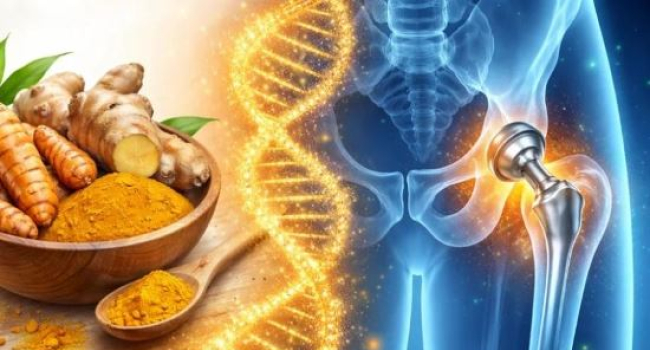
A new study from Washington State University suggests that extracts of turmeric and ginger can significantly improve the integration of bone implants, while also killing bacteria and cancer cells. This discovery could benefit millions of patients undergoing joint replacement surgery or treatment for bone cancer.
In preliminary experiments, the extract was found to nearly double the rate of bone growth around implants within six weeks. It also eliminated over 90% of bacteria on implant surfaces and significantly reduced the number of cancer cells. These findings combine elements of traditional natural medicine with modern biomedical technology.
Turmeric, a bright orange spice, and ginger root have been used for thousands of years in both culinary and medicinal practices in countries like China and India.
The study, published in the Journal of the American Ceramic Society, was conducted by researchers Bose and Amit Bandyopadhyay. Their work shows that compounds found in turmeric and ginger could become valuable additions to advanced medical treatments. The study builds on their earlier research into 3D-printed bone implants—a concept that was once considered futuristic but is now widely used in medicine.
In this study, scientists focused on common complications associated with bone implants. A significant number of implants must be replaced because they fail to properly fuse with bone or become unstable over time. In addition, infections on implant surfaces—often metallic—occur in nearly one-third of cases and are notoriously difficult to treat.
“In many cases, infections force doctors to remove the implant,” said Bose. “There are limited alternatives for stabilizing bone in such situations, so these complications can have serious medical and financial consequences.”
The extract was also tested on osteosarcoma cells, the most common type of bone cancer in children and young adults. Even after surgery, chemotherapy, and implantation, some cancer cells can remain in the body.
Researchers explored whether ginger extract and curcumin—the active compound in turmeric—could be applied to titanium implants and released gradually over time. The extract was tested both in laboratory conditions and in an animal study involving rat femur implants.
Results showed that the treated implants bonded much more effectively with bone, with approximately double the integration observed six weeks after surgery. The extract also destroyed 92% of bacteria on implant surfaces and reduced cancer cell presence around the implant by 11 times compared to untreated controls.
“This is a complex challenge,” said Bandyopadhyay. “We are developing implants that can resist infection to some extent while also strengthening the bond between bone and prosthetics—whether hip, knee, spine, or shoulder implants.”
Bose added that the antibacterial and anticancer effects of turmeric and ginger are just part of their broader health benefits. Both are known for their anti-inflammatory and antioxidant properties.
“I’m very excited about these natural compounds,” Bose said. “They could be easily used in everyday life as preventive agents. Curcumin has strong anti-inflammatory effects, and inflammation-related bone loss is a serious issue. Ginger may also have anticancer properties. These compounds have real preventive potential.”
Follow NEWS.am Medicine on Facebook and Twitter

- Related News
- When Diet and Exercise Aren’t Enough: Who Can Benefit from Weight-Loss Medications? If dietary changes and increased physical activity fail to produce at least 5% weight loss, patients can discuss medication options with their doctor...
- Tea May Benefit Heart Health — but Drinking It Scalding Hot Could Be Risky The study also found that moderate-strength tea was associated with a lower risk...
- A Simple Way to Blunt Blood Sugar Spikes After Meals In the experiments, mice were divided into groups after an overnight fast...
- Study: Healthy Diet During Pregnancy Reduces the Risk of Colic and Eczema in Children A higher MDS indicated a healthier diet rich in fruits, vegetables, whole grains, legumes, and healthy fats, with moderate amounts of dairy products and lean protein...
- F&F: Japanese Apricot May Help Fight Helicobacter pylori In experiments on mice, the extract reduced inflammation and promoted the restoration of the stomach lining...
- Video




- Event calendar
- Archive
- Most read
month
week
day
- Tea May Benefit Heart Health — but Drinking It Scalding Hot Could Be Risky 384
- Why Some People Avoid Alzheimer’s Despite Carrying a High-Risk Gene 348
- LSD does more than disrupt brain rhythms: It speeds them up and increases signal complexity 329
- Nine-year study links changing loneliness patterns to increased heart disease risk 320
- PLOS: Yogurt and Canned Beans May Help Reduce the Risk of Colorectal Cancer 295
- Scientists Rejuvenate Cells by More Than 60 Years for the First Time 286
- bioRxiv: Cholesterol May Interfere with the Brain’s Ability to Clear Toxic Proteins 270
- Nubar Afeyan’s Company Tests Skin Cancer Vaccine: Risk of Recurrence Falls by 42% 266
- Scientists Use ChatGPT-Like Technology to Assess Stroke Risk From Human DNA 257
- PLOS One: A Short Strength-Training Routine Improved Balance and Strength in Adults Over 65 249
- AJOG: Birth Weight Is Linked to Later Performance in Math and Reading 242
- Noise-Canceling Headphones Reduced the Risk of Nausea After Gynecological Surgery by 32% 233
- SciRep: Walking More Than 8,000 Steps a Day Is Linked to Better Attention 232
- WHO Comments on First Documented Human Death Linked to Shamonda Virus 222
- Scientists Unveil Scanner That Captures Whole-Body Images in Just 60 Seconds 219
- Find us on Facebook
- Poll