


- Latest news▼
-
23:22, September 7 How Can a Fly’s Brain Help Us Understand Human Behavior?

-
21:18, September 7 How the Pursuit of Perfect Sleep Can Keep You Awake

-
08:37, September 7 Weight-Loss Drug May Affect Aging: Scientists Discover an Unexpected Effect of Semaglutide

-
20:53, September 5 npj Science of Food: A Spoonful of Vegetable Oil Before a Carb-Rich Meal May Blunt Blood Sugar Spikes

-
13:26, September 5 In the U.S., Prescriptions for Obesity Drugs for Children Under 12 Increased 310-Fold in Seven Years

-
23:20, September 4 TCTV: New Drug Doubles Survival in Lung Cancer

-
11:10, September 4 SB: The Rule of Drinking Eight Glasses of Water a Day Has No Scientific Basis

-
08:46, September 4 JID: Popular Weight-Loss Drugs May Increase the Risk of Male Pattern Hair Loss by 7%

-
22:46, September 3 At-Home Urine Test Could Detect Most Bladder Cancer Cases, Study Finds

-
20:38, September 3 Alcohol-Related Cancer Deaths Double in the U.S. as the Number of Such Deaths Rises Over 33 Years

-
18:29, September 3 An Unexpected Paradox: Both Very Low and Very High Testosterone Levels May Be Equally Dangerous for the Heart

-
16:11, September 3 The Independent: Aging Is the Main Risk Factor for Cancer

-
14:13, September 3 CC: Age-Related Changes in Memory May Begin as Early as 50

-
08:34, September 3 Scientists Find Who May Benefit More from Coffee in Terms of Parkinson’s Disease Risk

-
23:37, September 2 LDE: Popular Diabetes Drugs Linked to Risk of a Dangerous Complication in Certain Patients

All materials
Ancient epidemics shaped the human immune system and may help explain severe COVID-19, study suggests
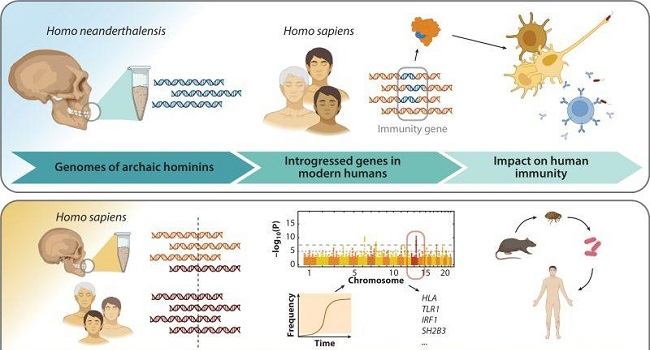
The human immune system has been shaped by thousands of years of exposure to infectious diseases, and traces of those ancient epidemics may still influence how people respond to infections today, according to a new study highlighted by News Medical.
Researchers from the University of Southern California and Howard University investigated the evolutionary history of four immune-related genes—IL-4, TLR2, CCL2, and SLC11A1. Their findings suggest that these genes have been shaped by natural selection over thousands of years in response to infectious diseases and other environmental pressures.
The scientists analyzed genetic data from more than 2,000 individuals from Africa, Europe, and Asia to determine how different versions of these genes became established in various populations. They found evidence that all four genes had undergone natural selection, although the evolutionary patterns differed across regions.
Some of the genetic variants identified were also found in Neanderthals and Denisovans. According to the researchers, this may reflect either shared ancestry or ancient interbreeding between early modern humans and these extinct human relatives.
The authors emphasize that these genetic changes arose long before the COVID-19 pandemic and reflect much older evolutionary adaptations to infectious diseases encountered by human ancestors.
The researchers then examined whether the same genes might influence the severity of COVID-19. Using genetic data from nearly 4,000 Italian patients enrolled in the GEN-COVID project, they identified two rare variants in the TLR2 gene.
One variant was more common among organ transplant recipients who developed COVID-19, while the other was associated with more severe forms of the disease. The findings suggest that inherited differences in immune-related genes may partly explain why some people experience more severe COVID-19 than others.
However, the researchers caution that these results require confirmation in larger populations and through additional laboratory studies.
According to the authors, understanding how the immune system evolved over time could help explain differences in people's responses to infectious diseases and may contribute to the development of new strategies for disease prevention and treatment.
Follow NEWS.am Medicine on Facebook and Twitter





- Most read
month
week
day
- An Unexpected Paradox: Both Very Low and Very High Testosterone Levels May Be Equally Dangerous for the Heart 956
- Alcohol-Related Cancer Deaths Double in the U.S. as the Number of Such Deaths Rises Over 33 Years 877
- The Independent: Aging Is the Main Risk Factor for Cancer 858
- CC: Age-Related Changes in Memory May Begin as Early as 50 848
- LDE: Popular Diabetes Drugs Linked to Risk of a Dangerous Complication in Certain Patients 846
- At-Home Urine Test Could Detect Most Bladder Cancer Cases, Study Finds 837
- Scientists Find Who May Benefit More from Coffee in Terms of Parkinson’s Disease Risk 715
- SB: The Rule of Drinking Eight Glasses of Water a Day Has No Scientific Basis 74
- JID: Popular Weight-Loss Drugs May Increase the Risk of Male Pattern Hair Loss by 7% 68
- TCTV: New Drug Doubles Survival in Lung Cancer 66
- Weight-Loss Drug May Affect Aging: Scientists Discover an Unexpected Effect of Semaglutide 65
- npj Science of Food: A Spoonful of Vegetable Oil Before a Carb-Rich Meal May Blunt Blood Sugar Spikes 63
- In the U.S., Prescriptions for Obesity Drugs for Children Under 12 Increased 310-Fold in Seven Years 62
- How the Pursuit of Perfect Sleep Can Keep You Awake 62
- How Can a Fly’s Brain Help Us Understand Human Behavior? 58
- Find us on Facebook
- Poll