


- Latest news▼
-
18:24, September 30 The Lancet Oncology: Infections Account for One in Eight Cancer Diagnoses Worldwide

-
16:30, September 30 Xinhua: Fatty Diet Leads to the Formation of 248 Gallstones in Man

-
14:21, September 30 ACS: Menthol Additive Significantly Prolongs and Intensifies the Effects of Nicotine
-
12:23, September 30 MM: Excess Dietary Salt Raises the Risk of Fatty Liver Disease in Lean People

-
08:26, September 30 Scientists Discover a ‘Pause’ in Metastasis Development When Cancer Cells Are Especially Vulnerable

-
22:54, September 29 A Drop of Blood and 10 Minutes: Scientists Develop Rapid Test for Stroke Medications
-
20:37, September 29 AI Learns to Detect Damaged Areas of the Heart from Electrical Signals Recorded at the Body Surface

-
18:30, September 29 Pomegranate compound may improve heart function by up to 80% in study

-
16:42, September 29 From Caffeine to Polyphenols: Scientists Trace What Happens to Coffee in the Gut

-
12:00, September 29 The Netherlands finds euthanasia of child under two years old lawful

-
23:17, September 28 A&D: Stable employment in midlife linked to slower age-related memory decline

-
21:22, September 28 More than 1,500 cases of West Nile virus infection recorded in Europe

-
19:32, September 28 İHA: Turkish patient has tube inserted into left ear instead of right during surgery
-
15:10, September 28 Cell: Effects of Alzheimer’s risk gene APOE4 on the brain may be reversible

-
13:13, September 28 Translational Psychiatry: “Fluctuating” brain signals linked to excess weight

All materials
A Drop of Blood and 10 Minutes: Scientists Develop Rapid Test for Stroke Medications
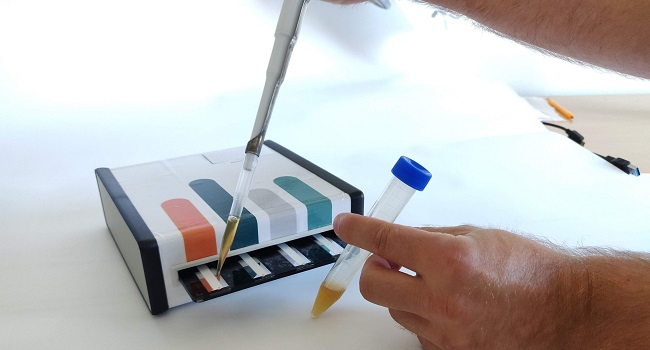
Scientists at Aarhus University in Denmark have developed a compact system that can determine the concentration of a drug directly in a blood sample in less than 10 minutes. The technology could be particularly useful in stroke treatment, when doctors need to quickly determine whether a patient is taking anticoagulants — blood-thinning medications.
The study results were published in the journal ACS Sensors. The technology has already been tested on blood samples from 52 patients.
For some types of stroke, doctors need to restore blood flow as quickly as possible, including with clot-dissolving drugs. However, such treatment can be dangerous for patients whose blood contains high concentrations of certain anticoagulants, increasing the risk of severe bleeding in the brain.
Today, a blood sample is usually sent to a laboratory to accurately determine the concentration of a drug. Even with urgent testing, it can take up to an hour to obtain a result. The new system makes it possible to perform the analysis directly inside a small device.
For the test, untreated blood is simply applied to a special chip inside a disposable cartridge. A built-in filter separates blood cells from plasma, after which reagents inside the cartridge react with the specific drug. An optical system detects the resulting signal and automatically calculates the drug concentration.
Centrifugation and other manual laboratory preparation steps are not required.
The technology is based on a biochemical analysis method developed by a team led by chemist Kurt Westergaard Gothelf. The researchers used specific antibodies capable of recognizing particular drug molecules, along with an optical signal generated when those molecules are detected.
So far, the technology has been tested on three anticoagulants — dabigatran, rivaroxaban, and apixaban. It was also used to measure concentrations of methotrexate, which is used to treat certain types of cancer, and the antibiotic linezolid. The results matched those obtained with conventional laboratory instruments.
The authors note that such a system could be useful not only in emergency medicine. The concentration of the same medication in the blood can vary significantly between individuals due to differences in absorption and metabolism. Therefore, in the future, similar devices could be used to personalize drug dosages.
The researchers are also considering applications outside major hospitals. The analyzer itself could cost around 30,000–50,000 Danish kroner, significantly less than large laboratory systems. This could potentially allow such devices to be installed in smaller medical facilities where a full laboratory is not available.
The technology is being developed by MedicQuant, a company founded by the researchers in 2019. The technology is currently undergoing further development and preparation for practical use. According to its creators, it may take another three years before it reaches the market.
Follow NEWS.am Medicine on Facebook and Twitter



- Most read
month
week
day
- Experimental RNA therapy may help prevent muscle loss during GLP-1 weight loss 946
- Armenian pediatric oncologist Gevorg Tamamyan has been nominated by Botswana for the position of WHO Director-General 813
- Study links overcrowding in emergency departments to hundreds of deaths each week 768
- Scientists develop device to obtain live cells from suspicious tissue for early cancer detection 765
- Breath test may help distinguish cancerous lung nodules from benign ones, study finds 753
- Introduction of solid foods triggers early functional changes in the infant gut microbiome 743
- Magnetic bacteria extend worms’ lifespan by more than 43%, study finds 741
- Chronic pain after cesarean delivery can affect women for years, study finds 710
- GLP-1 Drugs Linked to Nutritional Deficiencies in Nearly 1 in 6 Children 647
- Lund University receives $19.4 million NIH grant to develop Alzheimer’s blood test 641
- Virtual forest walk and classical music accelerated blood pressure reduction in emergency patients 638
- Could Earth’s magnetic field affect the aging process? 638
- Study: Loneliness and social isolation may cost up to six years of healthy life 618
- AI from Spain improves dermatological diagnosis 564
- NEG: 71% of People with Pulmonary Nodules Are Non-Smokers 519
- Find us on Facebook
- Poll