


- Latest news▼
-
20:56, October 23 Nubar Afeyan’s Company Tests Skin Cancer Vaccine: Risk of Recurrence Falls by 42%

-
18:49, October 23 bioRxiv: Cholesterol May Interfere with the Brain’s Ability to Clear Toxic Proteins
-
16:56, October 23 PLOS One: A Short Strength-Training Routine Improved Balance and Strength in Adults Over 65

-
14:50, October 23 A Simple 15-Minute Procedure Helped Patients with Carpal Tunnel Syndrome Avoid Surgery

-
12:53, October 23 Scientists Rejuvenate Cells by More Than 60 Years for the First Time

-
10:47, October 23 WHO Comments on First Documented Human Death Linked to Shamonda Virus

-
08:24, October 23 A Single Tooth Can Reveal Six Types of Information About a Person, Including Their Health

-
20:34, October 22 Medical Xpress: Hypnosis and Psychotherapy May Help Relieve Chronic Abdominal Pain in Children

-
18:51, October 22 Nature: Cold Triggers Muscles to Produce Protective Metabolite BH2

-
16:45, October 22 Nature: Hantavirus Enters Human Cells Through a Groove in a Receptor-Binding Protein
-
14:48, October 22 First Human Case of Shamonda Virus Infection Recorded in France

-
12:43, October 22 Chinese Scientists Develop a One-Gram Device for Monitoring Brain Activity

-
10:55, October 22 LSD does more than disrupt brain rhythms: It speeds them up and increases signal complexity
-
08:42, October 22 The Journal of Nutrition: Women Who Eat Oily Fish Have a 19% Lower Risk of Death from Stroke

-
23:27, October 21 Nine-year study links changing loneliness patterns to increased heart disease risk

All materials
Next-Generation Catheter Developed to Examine Dangerous Plaques Inside Coronary Arteries
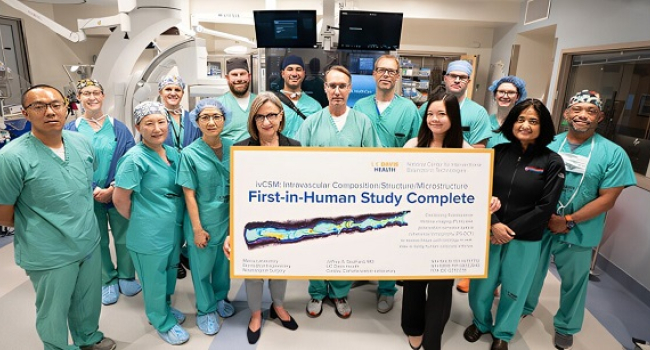
Researchers at the University of California, Davis, have completed the first human trials of a device that enables real-time examination of the structure and chemical composition of atherosclerotic plaques inside coronary arteries, according to a university statement.
The new technology could help doctors assess the risk of plaque rupture more accurately and make better-informed treatment decisions.
The flexible catheter was developed by specialists at the National Center for Interventional Biophotonic Technologies (NCIBT). It combines two imaging techniques: fluorescence lifetime imaging (FLIm) and polarization-sensitive optical coherence tomography (PS-OCT). The first method assesses the biochemical composition of tissue based on its natural fluorescence, while the second examines its microstructure.
During the procedure, the catheter is inserted into the coronary arteries, where it rotates and is gradually withdrawn while capturing images. The device can scan an 80-millimeter section of an artery in just two seconds. It can detect plaque buildup before significant stenosis — an abnormal narrowing of a blood vessel that can impair normal blood flow — develops.
Existing intravascular imaging techniques, including optical coherence tomography and ultrasound, help doctors assess blood vessel structure but do not provide the same level of information about biochemical composition. Yet the characteristics of plaques can indicate inflammation and an increased risk of rupture. This is important because detached plaque fragments and the blood clots that form can cause heart attacks and other serious complications.
“This technology could help physicians better understand the progression of atherosclerotic cardiovascular disease and tailor treatment to each patient’s individual characteristics,” said Laura Marcu, founder of NCIBT.
The device was previously tested on animals and samples of human coronary arteries. This year, the US Food and Drug Administration (FDA) authorized a study involving 10 patients. In August, the research team completed imaging procedures on the final participant.
The next step will be to expand the study. Ultimately, the developers hope to introduce the catheter into cardiac catheterization laboratories, where it could help clinicians characterize plaques more precisely and select optimal locations for stent placement. Stents are small devices used to keep narrowed arteries open.
Follow NEWS.am Medicine on Facebook and Twitter

- Video



- Event calendar
- Archive
- Most read
month
week
day
- Cardiologists Urge Inclusion of Physical Exercise in Heart Disease Prevention 562
- Why Some People Avoid Alzheimer’s Despite Carrying a High-Risk Gene 313
- Nine-year study links changing loneliness patterns to increased heart disease risk 303
- LSD does more than disrupt brain rhythms: It speeds them up and increases signal complexity 302
- Tea May Benefit Heart Health — but Drinking It Scalding Hot Could Be Risky 297
- PLOS: Yogurt and Canned Beans May Help Reduce the Risk of Colorectal Cancer 270
- AJOG: Birth Weight Is Linked to Later Performance in Math and Reading 209
- Noise-Canceling Headphones Reduced the Risk of Nausea After Gynecological Surgery by 32% 205
- SciRep: Walking More Than 8,000 Steps a Day Is Linked to Better Attention 191
- Anesthesiology: Noise-Canceling Headphones Reduce the Risk of Nausea After Anesthesia 177
- Nature: AI Links Brown Fat to Heart, Vascular, and Mental Health 171
- Polyphenols in coffee and fruit linked to lower risk of telomere shortening 166
- Postoperative Monitoring Apps Reduced Hospital Readmissions by 15% 154
- Scientists Unveil Scanner That Captures Whole-Body Images in Just 60 Seconds 153
- HealthDay: Strength Training After 60 Helps Strengthen Bones and Maintain Brain Health 142
- Find us on Facebook
- Poll