make preferable
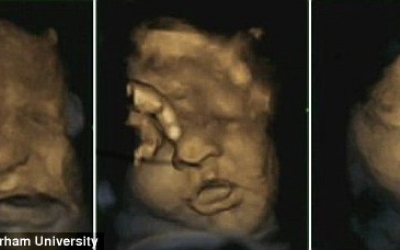
Unborn babies practise smiling while still in the womb, scientists have discovered.
A series of detailed 4D scans reveal babies running through facial expressions up to 16 weeks before they were born, the Daily Mail reported.
Psychologists say the images show infants practising expressing their emotions so they are ready to bond with their parents at birth.

The study, which took ultrasound scans of 15 healthy foetuses at regular intervals between 24 and 36 weeks of pregnancy, suggests that babies refine the neurological ability to show emotion very early in their development.
Using 4D scans which captured frame-by-frame pictures, the scientists tracked the foetuses’ mouth movements and compared it to the development of the different parts of their brains.
The right side of the human brain is related to emotional skills and controls the left-sided mouth movements, whereas the left side of the brain is linked to language skills, and controls the right-hand side of the mouth.
The researchers found that the mouth movements they tracked were significantly biased towards emotional left-sided movements.
They concluded that foetuses practise making the mouth movements they will need after birth to convey emotions such as smiling to bond with their parents.
The study, published in the journal Physiology and Behaviour, found the left side of the faces of all 15 babies - eight girls and seven boys - were more expressive.
Lead author Dr Nadja Reissland, of Durham University’s department of psychology, said: ‘As the left hemisphere of the brain is larger in foetuses from 22 weeks you would expect to see that the right side of the child’s face is more expressive, but we found the opposite.
Expressions include crying and smiling as well as signs of pain, identified by simultaneously furrowing the brow, wrinkling the nose and raising the lip.

The images showed that as foetuses matured they began to increasingly touch the lower, more sensitive, part of their faces including their mouths.