


- Latest news▼
-
17:38, October 3 Study: Suicidal Ideation Among US Teens Began Rising Sharply After Nearly Two Decades of Decline

-
15:21, October 3 Food & Function: Daily Consumption of 40 Grams of Walnuts Linked to Improved Overall Mood

-
12:43, October 3 WHO: Global Life Expectancy Has Almost Returned to Pre-Pandemic Levels

-
08:36, October 3 Dr. Andrews: Dizziness May Indicate Thyroid Dysfunction

-
23:31, October 2 Ophthalmology: Tooth Discovered Growing in Upper Orbit of 16-Year-Old Indian Teenager
-
20:19, October 2 Food & Function: Peanuts Increase Brain Insulin Sensitivity in Older Adults
-
18:14, October 2 Radiology: Low Spine Bone Density Linked to Cognitive Decline
-
16:12, October 2 Biological Psychiatry: Semaglutide Significantly Reduces Heavy Drinking Days

-
14:10, October 2 Diabetes, Obesity and Metabolism: Feijoa Improved Blood Pressure in People with Prediabetes

-
12:09, October 2 JACH: A Busy Schedule Improves Mental Health

-
08:45, October 2 Chewing Tobacco Killed 251 Thousand People in 2023: 84% of Deaths Occurred in South Asia

-
23:35, October 1 Thailand’s Health Ministry Warns of Leptospirosis in Flood-Affected Areas

-
21:29, October 1 Nearly 95% of Viral Videos on Korean “Glass Skin” Care Contain Misleading Advice, Scientists Find

-
19:24, October 1 ABC News: 40% of the World’s Population Was Exposed to Dangerous Ozone Levels This Year

-
17:18, October 1 CDN: Fruit Juice Does Not Lower Heart Disease Risk Like Whole Fruits

All materials
Ophthalmology: Tooth Discovered Growing in Upper Orbit of 16-Year-Old Indian Teenager
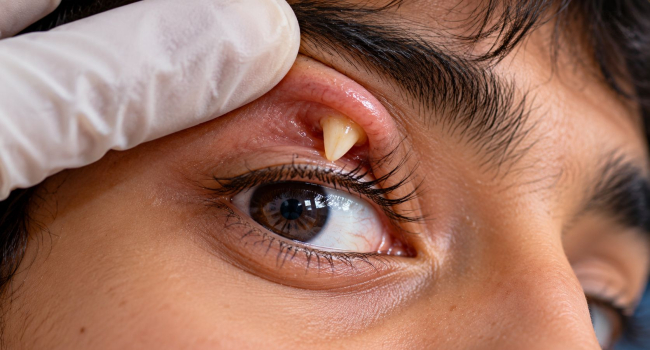
Doctors in India have discovered a rare ectopic tooth in a 16-year-old boy, located in the upper portion of his eye socket, beneath the eyebrow. Such a location for a tooth had never previously been documented in medical literature. Ophthalmologists from the Aravind Eye Hospital in Madurai, Tamil Nadu, reported the unusual case, which was detailed in the journal Ophthalmology.
The teenager sought medical attention due to a painless swelling in his upper eyelid that had persisted for about a month. There was no history of trauma prior to the appearance of the mass. Upon examination, specialists found two whitish, hard protrusions on the inner aspect of the left upper eyelid, near the nose.
Initially, doctors suspected the growth might be a teratoma—a rare tumor capable of containing various tissue types, including bone and dental structures. However, a computed tomography (CT) scan revealed a structure resembling a fully formed tooth with both a crown and a root. It originated from the roof of the left orbit, extended forward, and protruded externally in two fragments.
According to the authors, ectopic teeth—teeth located outside the normal dental arch—have been described in various unusual anatomical sites, including the nasal cavity, maxillary sinus, and the floor of the orbit. However, a tooth situated in the roof of the orbit represents the first known case of its kind.
"This was a first not only for us, but globally," said study co-author Meghana Tanwar.
The adolescent underwent surgical excision of the mass. Histopathological examination confirmed mature dental tissue with no features of a teratoma, validating the diagnosis of an ectopic tooth. No other aberrantly located teeth were detected on imaging.
The precise etiology of the intraorbital tooth remains unknown. Potential contributing factors for such developmental anomalies include aberrant tissue differentiation, trauma, infection, and genetic predisposition.
Teeth located completely outside the dental arch occur far less frequently than standard malocclusions. The authors highlight that this case is particularly extraordinary due to the complete displacement of the dental structure beyond the jawline and its direct placement within the upper orbit.
Follow NEWS.am Medicine on Facebook and Twitter




- Most read
month
week
day
- The Lancet Oncology: Infections Account for One in Eight Cancer Diagnoses Worldwide 547
- ACS: Menthol Additive Significantly Prolongs and Intensifies the Effects of Nicotine 535
- Neuron: Lymph Node Removal Associated With a 25% Rate of Cognitive Impairment 526
- Xinhua: Fatty Diet Leads to the Formation of 248 Gallstones in Man 484
- Pomegranate compound may improve heart function by up to 80% in study 475
- Thailand’s Health Ministry Warns of Leptospirosis in Flood-Affected Areas 450
- Anti-Cancer Associations of China, Egypt and Kazakhstan Support Gevorg Tamamyan’s Candidacy 431
- ABC News: 40% of the World’s Population Was Exposed to Dangerous Ozone Levels This Year 427
- MM: Excess Dietary Salt Raises the Risk of Fatty Liver Disease in Lean People 405
- PLOS Medicine: Brain Age Gap Was Largest in Dementia 388
- Biomolecules: Mulberries May Improve Gut Health and Metabolism 373
- CDN: Fruit Juice Does Not Lower Heart Disease Risk Like Whole Fruits 369
- The Netherlands finds euthanasia of child under two years old lawful 357
- Scientists Discover a ‘Pause’ in Metastasis Development When Cancer Cells Are Especially Vulnerable 298
- A Drop of Blood and 10 Minutes: Scientists Develop Rapid Test for Stroke Medications 273
- Find us on Facebook
- Poll