
 make preferable
Chemotherapy: One of the most effective methods against cancer can be also one of the most toxic.
Although chemotherapy drugs can successfully stop or slow the growth of cancer cells in the body, they can also harm healthy cells in the process – leading to unwanted side effects, such as fatigue, nausea and hair loss, reports Fox News.
But now, there may be a way of providing patients with a more focused form of chemotherapy – by using innovative “nanoballoons” and lasers. Developed by researchers at the University at Buffalo, these miniscule particles can deliver anti-cancer medications straight to the tumor itself, without causing unwanted damage along the way.
“In the past 10 or 20 years, there’s been a lot of interest in using nanoparticles in order to carry drugs to the tumor, and part of the hope is it reduces some of the toxic side effects of the drugs,” corresponding author Jonathan Lovell, assistant professor of biomedical engineering at the University of Buffalo, told FoxNews.com. “…That’s the problem [now]: Only a very small fraction of the drugs that you actually give to a patient ends up in the tumor – so if you’re lucky, it’ll be a few percent, but maybe even less than that.”
Harnessing this nanoparticle concept, Lovell and his team developed their own nanoballoons – also referred to as PoP-liposomes. Approximately 1,000 times smaller than a human hair, the balloons are comprised of chlorophyll, an organic pigment found in green plants, and phospholipid, a fat similar to vegetable oil. Because of this unique composition, the nanoballoons are capable of completely encapsulating anti-cancer drugs, shielding them from other healthy bodily systems.
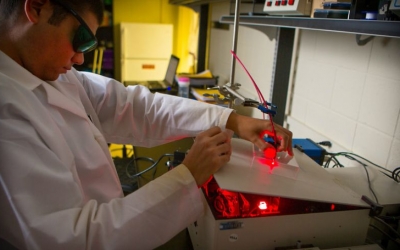
Once the drugs are trapped inside these containers, the tiny balloons are injected into the bloodstream and diffuse throughout the body. Then, the researchers hit the PoP-liposomes with a red laser right at the site of the targeted tumor – triggering the balloons to “pop” open and release the chemotherapy drugs.
To demonstrate the effectiveness of this method, Lovell and his team tested their invention on mice that had tumors growing on the surface of their skin. Using their laser/nanoballoon combination, the mice were completely cured of their cancers after a few treatments. And, since the chemotherapy drugs did not affect the rest of the body’s systems, the researchers did not need to use as much of the drug to get their desired results.





